The advent of the printing press sparked a revolution in the distribution of informative material in the 15th century in Europe. Not only did the invention of the press provide unforeseen advancement in the production of books, but in doing so it served as a catalyst for social change. By analyzing five examples of books produced during the time surrounding the advent of the printing press, I hope to achieve a better understanding of not only the difference that the printing press made in the physical production of material books and development in bookmaking as a physical process, but also how the process of printing books changed the way that society perceived the distribution of information and how changes in bookmaking directly relate to societal reform in the fifteenth century in Europe.

1. The Book of Kells
The first book I chose to analyze is The Book of Kells, which is undoubtedly the most famous example of the insular manuscripts and Celtic hand-illumination, the method of bookmaking that was prominent before the invention of the press. Created by Celtic monks around the year 800 in Ireland, the Book of Kells is the physical representation of the process of bookmaking prior to rise of the press in the mid-1400s.
The book itself is comprised of the four Gospels of the Bible, each hand-scripted in the traditional Insular majuscule, the traditional medieval writing system which is recognizable through its use of diminuendo (oversized initials at the beginning of a block of text that, by the end of the text line, gradually shrink to the normal text size) as well as historiated initials (enlarged and heavily illustrated letters at the beginning of a paragraph).
Because of the complicated hands-on process of creating the text itself, it is understandable that the actual letterforms in the insular manuscripts contributed heavily to the overall aesthetic of the work. In a sense, the text itself contributed just as much to the aesthetic value as the purely decorative elements, such as the carpet pages, This is one of the aspects that makes the Book of Kells as well as all the Insular manuscripts so different from works created after the printing press. The uniqueness and extreme attention to detail that comes from hand-illumination cannot be duplicated in the use of a press.
The majuscule is recognizable as the work of at least three different scribes, which is understandable considering the length of the text. The process in which the monks worked together in a scriptorium, or writing room, was an elaborate team effort, requiring various scribes and artisans who were trained specifically to perform different tasks throughout the complex process of the creation of the book.
The illustration and decorative qualities of the book were of the utmost importance, not merely serving for aesthetic pleasure, but actually intended to be used for their educational value as visual imagery and, according to Meggs, used to "create mystical and spiritual overtones." For this reason, the Book of Kells contains more ornamental elements than most books in the history of bookmaking. Not only are there full pages of entirely illustrated elements, or carpet pages, but there are also zoomorphic images, intricate knot work, and complicated lacertines.
The book was physically comprised of hundreds of sheets of expensive and high-quality calf vellum, and each set of pages, or folio, was hand-bound into four volumes. The final result was an incredibly costly piece of work. It is because of this unbelievably complicated process that very few books were created during this time, and the lack of reading material, which coincided with the extreme illiteracy that plagues Europe at the time, is understandable. Later advancements in bookmaking and printing techniques provided ways for books to be created without the backbreaking intensive labor of the Scriptorium. It is because of this new efficiency that the printing press and its surrounding advancements can be credited as one of the most valuable inventions in history.

2. The Commentary of Beatus on the Apocalypse of Saint John the Divine
The next work I chose to compare is the Commentary of Beatus on the Apocalypse of Saint John the Divine, which was an interpretation of the book of Revelation, written in 776 A.D. by the scribe Beatus, for the King and Queen of Spain. Created in multiple versions throughout Spain, this work is an example of the style and accomplishments of the various Spanish scriptoriums.
The Spanish style was distinctive from that of the Book of Kells and other Insular manuscripts because of Spain's unique combination of Christian religious and Moorish design influences. In fact, several recognizable Islamic motifs are seen pervading throughout the various Commentaries of Beatus as well as several other works produced by the Spanish Scriptoriums. The Spanish designs reflected a desire for "intricate geometry and intense, pure color."
Similarly to the Book of Kells, the richly detailed illustrations in the Commentary of Beatus held high importance to the overall work. The stark, bold imagery provided strong visual interpretation for the jarring stories from the Book of Revelation.
The attempt to visualize these horrifying apocalyptic scenes demonstrates a cultural obsession with the end times and preparation for the Apocalypse. The illustration and distribution of Beatus's Commentary helped to form a widespread cultural panic at the turn of the first century A. D., when the end was believed to be coming. The effect that the production of these books, even in their small number, had on the general population can be considered a precursor to the effect that the development of printing technique and the distribution of printed good had on the society of Europe.

3. The Gutenberg Bible
The printing press was invented by Johannes Gutenberg in 1450 in Germany. The first book to be printed in the movable type printing method was Gutenberg's 42-Line Bible, often referred to as the Gutenberg Bible. The production of the Gutenberg Bible ushered in the age of the printed book.
This first printed book didn't create much of an immediate stir, as the copies were sold as manuscripts like any other. However, as soon as news spread of Gutenberg's invention, printing spread across Europe. By 1480, sixty-eight European towns had printing presses, and the numbers grew rapidly from then on. Printing became a cultural phenomenon as libraries began popping up in monasteries and personal collections across the continent. Books were less of a treasure and more of a commodity. Printed matter stood for change.
The craze for these books eventually spilled into a demand for newspapers, flyers, tracts, posters, and more. The production method was unbelievably affordable and timely than the creation of traditional manuscripts, allowing books and other printed materials to be sold and distributed for a fraction of the earlier cost. The excess of printed material found its way into the hands of the common man, and illiteracy rates began to fall.
Because Gutenberg's invention was the first machine to take place of human labor, it sparked a revolution. There was no longer a need for an entire scriptorium of trained craftsman slaving away over the production of one book. Rather, production became a relatively thoughtless process. The idea that man could create machines to do work efficiently and professionally eventually led to the ideas that formed the Industrial Revolution.
Because of the efficiency of production, the physical result looked quite different than the hand-illuminated manuscripts that Europe had come to recognize as books. Forty-five copies were printed on vellum, while 135 copies were printed on fine handmade paper that contained a watermark. The pages were double-sided, allowing for them to be folded and bound in a more effective manner.
The availability of books led to widespread increase in education, allowing the common man an opportunity to think for himself rather than listening to what the community leaders told him to believe. Obviously these ideas trace back to the basics of the social changes that were sweeping Europe and the growing value of individual thought. This radical change in thought shows itself most prominently in the area of religious thought, where men dared to think independently and place value in their own opinions and interpretations of Scripture. Martin Luther's shockingly bold Ninety-five Theses used the power of the press to create a stir across Europe, leading to the rise in independent religious thought, which culminated in the Protestant Reformation.

4. The Nuremberg Chronicle
The invention of the printing press developed further specifically in Germany, where groups of printers and illustrators collaborated to break out of the norm of simply using the press to reproduce and distribute aged works. These artists were drawn to the idea of combining woodcut prints with typographic books to allow for a wide range of possibilities in the inclusion of illustration into the printing process. Previously, the books were printed and left the shop completely unadorned, sent off to various artisans and illustrators who provided detailed illustrative work by hand, similarly to the process of the Scriptorium. These roots slowly faded as artists discovered how to incorporate their illustrations into the printing process.
The most impressive example of work to come from this era is the Nuremberg Chronicle. Printed in 1493, this six-hundred page monster is an account of the history of the world as written by the scholar Dr. Hartmann Schedel. Printed at Nuremberg, at the largest and more successful printing company, owned by Anton Koberger, the Nuremberg Chronicle is considered a masterpiece of its time, containing 1,809 of the revolutionary complex woodcut illustrations.
The Nuremberg Chronicle marks the move away from tiny print shops and toward massive, large-scale production companies. Anton Koberger owned twenty-four presses, and employed over a hundred craftsmen to complete the printing process. He sold his printed products throughout Europe in the sixteen shops that he owned.
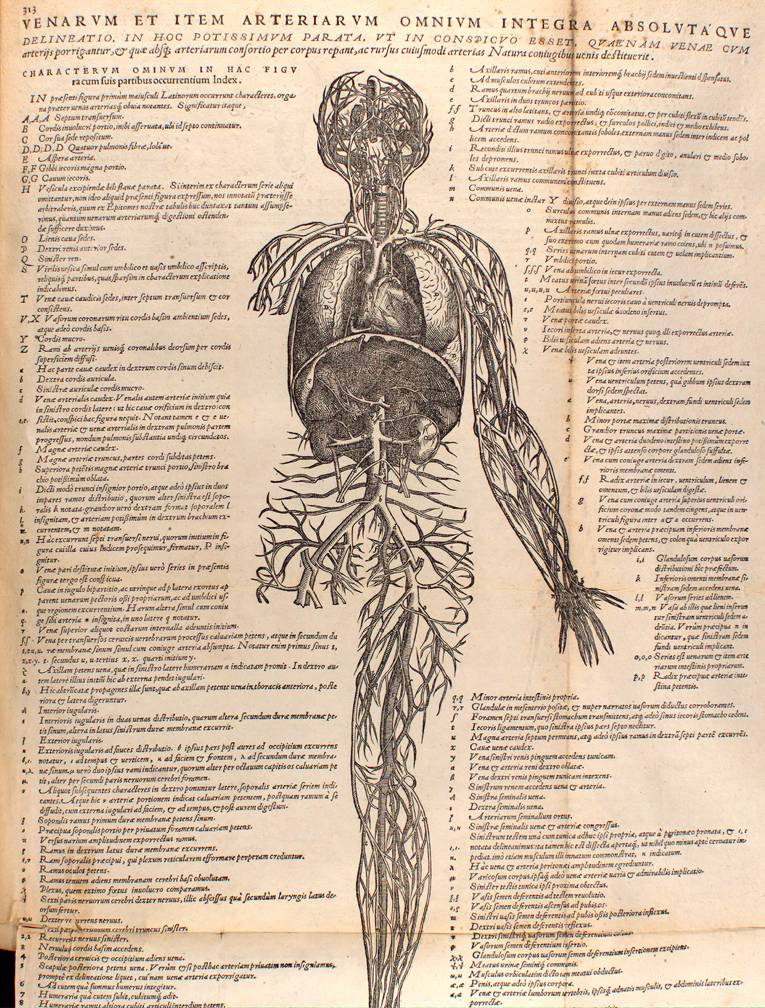
5. De Humanis Corporis Fabrica
Major change in thought and method concerning bookmaking came about as the result of the Italian Renaissance. Italian designers and scholars brought a new set of values to the process of printing. Because the focus of the Italian Renaissance was on the spread of knowledge and a heightened appreciation for scientific fact, the leaders of this movement were less concerned about the detail of ornamentation and illustration, and more concerned in the quality and legibility of universal type treatments. Demand was high for expert calligraphers to instruct the growing literate public how to write properly, and this speedy process of education led to a largely uniform style of writing that covered Europe.
One example of how bookmaking became a vehicle for the spread of scholarly thought and the development of new social ideas is seen in the printed masterpiece entitled "De Humani Corporis Fabrica." Printed in 1543 by the master printer Johann Oporinus, this 667-page book contained full-detailed descriptions of human anatomy, as presented by Andrea Vesalius, the founder of modern anatomy. Full-page woodcut illustrations were prepared by highly skilled artisans who drew directly from human cadavers to provide scientifically accurate representations. The book was highly applauded for its scientific clarity, wordy text, and precise printing methods that allowed for such advances as page numbers and italics. The immense popularity of this book highlights not only the advancements in modern printing techniques, but also the appetite for the spread of scientific knowledge that characterized the Italian Renaissance.